
Why do some recruiters close retained projects in a single meeting while others pitch for weeks and still lose to contingent competitors?
James O’Brien knows exactly why.
And it has nothing to do with your fee structure.
This episode is for recruiters who are tired of pitching, discounting, and competing with five other agencies for the same role.
At the centre of James’ approach are three questions that expose hidden hiring failure and reframe the entire sales conversation. You’ll hear those questions in full, plus why most recruiters lose retained work in the preparation (not the pitch), and how to position yourself as a management consultant who specializes in talent acquisition rather than just another recruiter chasing job orders.
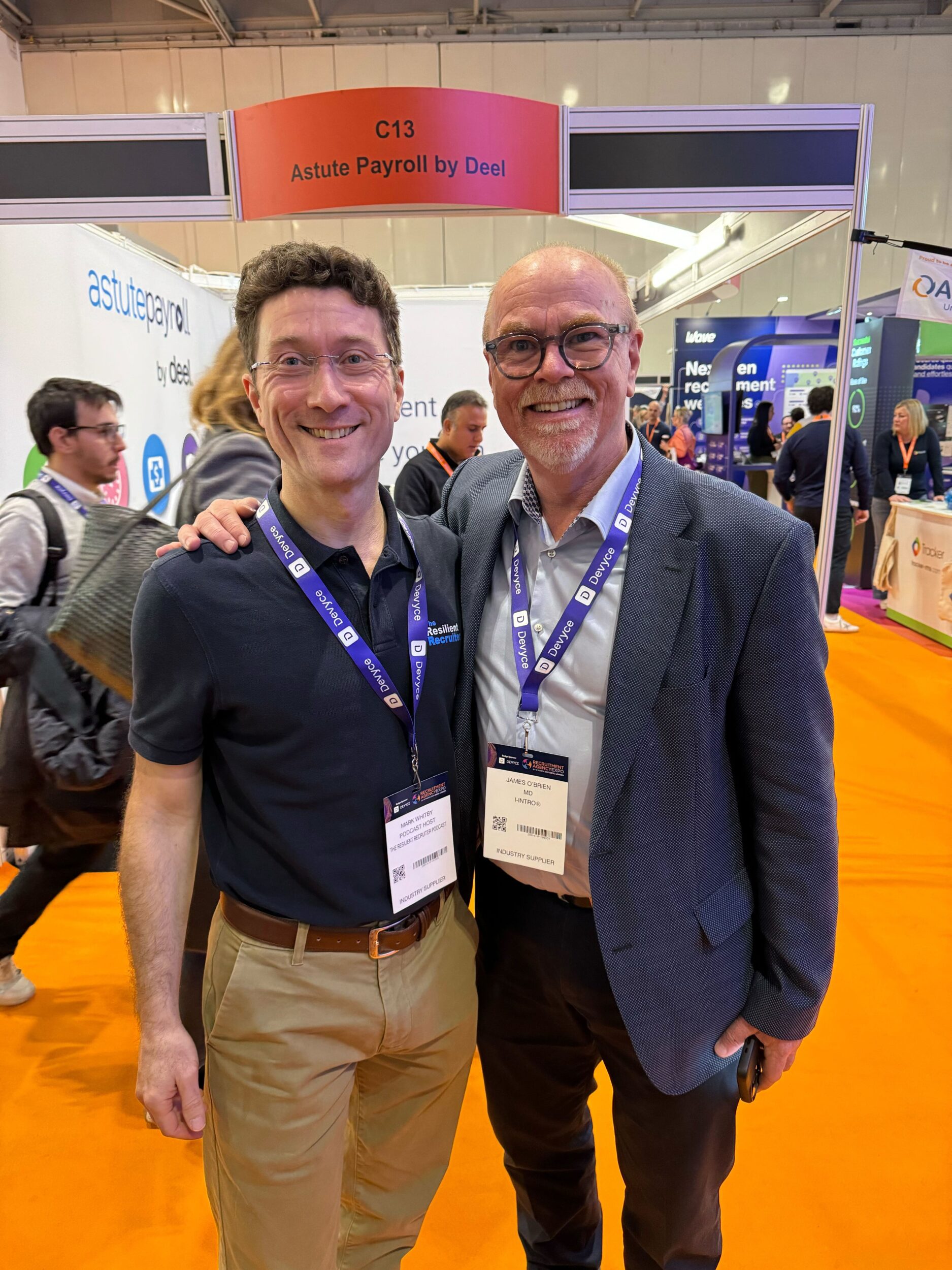
James is the Managing Director and COO at i-intro. He’s been in recruitment since the late 1980s and has spent the last decade helping hundreds of recruitment firms transition from contingent to retained assignments. His clients achieve a 96% one-year retention rate and 93% of placements are still in the job two years later.
In this episode, you’ll learn how to ask better questions, run discovery meetings that clients actually thank you for, and close retained work without needing to be the cheapest option in the room.
Episode Outline and Highlights
- [03:56] Why transactional recruitment is dying (and what’s replacing it)
- [10:13] Recruitment’s not the problem retention is (and why most recruiters don’t measure it)
- [13:34] How to measure your retention rate and use it to monetize bigger fees
- [18:00] The three questions that reveal a client’s 20-30% hiring failure rate
- [32:23] Why “wow” should be your standard for every client meeting
- [36:35] The preparation process that wins retained work before you walk in the door
- [45:00] Why proposals still matter (and when to send them)
- [59:03] How to make yourself accountable beyond the placement (12-month guarantees that actually work)
Recruitment’s Not the Problem, Retention Is
Most recruiters think their job is filling vacancies fast.
James thinks that’s the problem.
“Recruitment’s not the problem. Retention is the problem. It’s not something that’s measured by internal talent acquisition teams. And it’s a stat that is not measured by many recruitment firms either.”
Talent acquisition teams focus on time-to-fill. Recruiters focus on delivery and results. But nobody’s tracking what happens six months later when the hire walks out the door.
Here’s the uncomfortable truth: when you ask an employer how many of their last 10 hires are still with the company after a year, the answer is almost always seven or eight.
Why that number?
Because it feels psychologically safe. Seven or eight out of 10 is good. It’s a passing grade.
But flip it around.
That means 20-30% of new hires fail. And if you ask any employer whether they’d accept a 20-30% failure rate in any other business process, the answer is always no.
This is where the conversation shifts.
James uses three killer questions in every discovery meeting:
“Of your last 10 hires, how many are still with you after a year?”
Most clients say seven or eight. Some say they don’t know (in which case you ask for their best guess).
“So that means 20-30% of your hires are failing. Is that right?”
Reframe their answer. Make them hear it differently.
“Is there any other process in your business where you’d accept a 20-30% failure rate and just let it keep running?”
Silence. Every time.
This is where you stop being a recruiter and become a management consultant specializing in talent acquisition.
Because recruiters fill jobs. Management consultants fix problems.
Show the Value Don’t Just Describe It
Once clients see the real cost of hiring failure, the next question becomes: how do you prove you can do better?
James learned this lesson years ago from his brother-in-law, who ran a marketing agency.
They were pitching for a retail insurance contract worth £1.5 million in year one. James watched them spend £10-15k preparing for the pitch. Physical mock-ups. Branded materials. Tangible proof of what working with them would look like.
He asked: “What if you don’t win it?”
The answer: “What if I don’t win it because I didn’t put the effort in to show them what it’s going to be like working with us?”
They wanted the client to touch it. Feel it. Experience it in the meeting.
James brought that thinking into recruitment.
“I want to show clients physically what they’re going to get. Don’t turn up for your meeting without showing the client you mean business. Show them what it’s going to be like if you work with us.”
He’s not talking about PowerPoint slides.
He’s talking about candidate packs branded in the client’s colors. Onboarding questionnaires with scoring ratios. Retention tracking systems. Accountability checkpoints at 3, 6, 9, and 12 months.
Things that make clients say: “I’ve never seen this from any other recruiter.”
That’s the standard. Wow.
“If you just trot out of the room after five other recruiters, you might win your share. But if you want to stand out, you need to show them something they’ve never seen before.”
Words are cheap. Anyone can say they have a better process.
Showing them makes it real.
Preparation Wins Retained Work (Not the Pitch)
Client meetings are gold dust.
They’re harder than ever to secure. Which means turning up unprepared is the fastest way to lose the business.
James sees this all the time. Recruiters get the meeting. Then they wing it.
“When you prepare for meetings, you’ve got to prepare for success. You’ve got to ask the right questions in the right order. And when you do that, clients start to see you differently. You’re not just there to fill a job. You’re there to fix a problem.”
Here’s what preparation looks like:
Before the meeting, build the proposal template. It’s 90% done before you even sit down. All you’re changing are the client-specific details. That way, when the meeting ends at 1pm, you can send the proposal by 2pm (though James sometimes waits a bit so it doesn’t look too easy).
Research the client on LinkedIn. How many people have they hired recently? How many have left? You should walk in with a rough idea of their retention rate before you ask the question.
Prepare branded materials. Candidate packs. Performance sheets. Whatever you’re going to show them to demonstrate your process. Don’t just talk about it.
Ask yourself: what could make this client say “wow”?
Because if you’re just another recruiter in the rotation, you’ll compete on price. But if you show them something they’ve never seen before, price becomes irrelevant.
James put it perfectly:
“People buy premium products when they understand the value. If they don’t understand the value, they’ll buy the cheapest option, which in recruitment is contingent, no-win-no-fee placement.”
The goal isn’t to be the cheapest. The goal is to make the value so clear that your fee feels fair.
If you want to win retained work consistently without pitching, discounting, or chasing clients, this episode will change how you run every client meeting.