
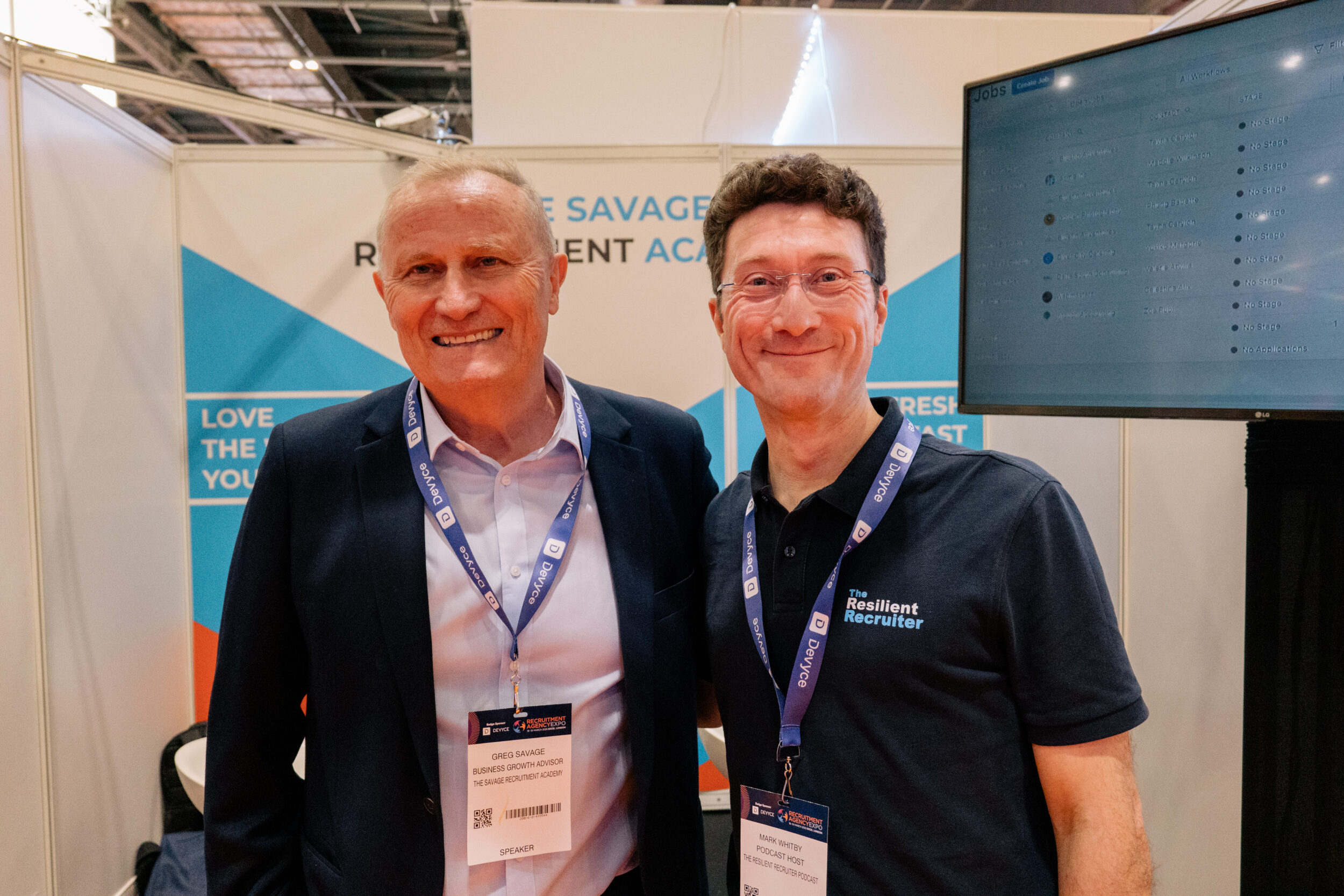
Six years ago, when I launched The Resilient Recruiter, my very first guest was Greg Savage.
Since then, we’ve lived through a global pandemic, a hiring boom, a market correction, and now the fastest wave of AI adoption our industry has ever seen.
So for episode 300, it felt right to bring Greg back.
And he didn’t hold back.
“The contingent, multi-listed perm market… I think that is over.”
Greg has built four recruitment businesses. He’s the author of The Savage Truth. He’s spent five decades watching this industry evolve.
His view?
AI hasn’t made recruitment easier.
In many ways, it’s made it harder.
But it has also created an opportunity for recruiters who elevate.
What Greg Predicted in 2023 And What’s Changed
In September 2023, Greg laid out a series of predictions about how AI would reshape recruitment.
He argued that:
- AI would automate parts of recruitment, but never the whole process
- Human judgment and advisory skills would become more valuable
- Blind tech adoption would create confusion
- Some parts of recruitment would become harder, not easier
- Technology should enable connection, not replace it
Two years later? Those predictions were “scarily accurate.”
But in some areas, the situation has accelerated faster than expected — particularly around screening inconsistency, resume fraud, and the pressure on contingent recruitment models.
Episode 300 is, in many ways, a distilled update on that thesis.
What’s proving true.
What’s breaking.
And what recruitment leaders need to do next.
Episode Outline and Highlights
- [00:33] The biggest threat — and opportunity — Greg has seen in decades
- [02:14] Why the contingent, multi-listed perm model is under pressure
- [06:34] AI screening chaos and the 14% shortlist overlap test
- [08:32] What “automating dysfunction” really means
- [13:03] Fewer recruiters, higher revenues?
- [26:20] The highest ROI AI opportunity right now
- [30:43] The four questions to ask before buying any AI tool
- [54:04] The rise of the “techno-empath” recruiter
Why AI Is Making Recruitment Harder, Not Easier
AI was supposed to increase efficiency.
Instead, Greg sees confusion, inconsistency, and new risks emerging.
A researcher tested three major AI screening tools using the same 100 candidates and identical job specs. Each was asked to produce a shortlist of five.
There was only 14 percent overlap between them.
Run the same tool the next day? Different results.
The strongest candidates? Missing entirely.
That alone should make every recruitment leader pause.
Then there’s fraud.
Recent data suggests that around 40 percent of tech candidates have materially inflated their resumes. The FBI uncovered more than 1,000 North Korean operatives who secured jobs inside Fortune 500 companies using fraudulent interview techniques.
When candidates use AI to enhance or fabricate their experience, screening becomes more complex, not simpler.
And then there’s what Greg calls “automating dysfunction.”
One vendor proudly showed him a system that detects when a candidate has a baby and automatically sends congratulations.
Greg’s response was simple:
If you want to wish someone well, call them. Do it properly. Or don’t do it at all.
Just because something can be automated doesn’t mean it should be.
Recruitment isn’t e-commerce. What we’re placing can say no. Candidates change their minds. Clients shift direction. Counteroffers happen. Emotion influences every outcome.
Blind automation damages trust.
Before implementing any AI tool, Greg suggests asking:
• What recruitment problem does this solve in my business?
• Does it improve the candidate experience?
• Does it improve the recruiter’s experience?
• Does it improve the hiring manager’s experience?
If the answer is no to any of those, think carefully.
That filter alone will eliminate most shiny-object purchases.
The End of the Resume Race
Greg believes the contingent, multi-listed perm model is under real pressure.
Four agencies are racing to send CVs first. Speed over depth. Volume over value.
That part of recruitment is exactly what technology can disrupt.
If your competitive advantage is “faster than the next recruiter,” eventually AI will win.
But here’s what won’t be beaten so easily:
Deep job intake conversations where you diagnose the real hiring problem
Challenging client assumptions
Selling opportunity to passive candidates
Managing offers and counteroffers with nuance
Coaching both sides through uncertainty
Those are the moments of truth.
Greg sees three models positioned to survive and grow:
Retained search. Built on trust, expertise, and advisory relationships.
Sophisticated contract recruitment. As the gig economy expands, complex contract placements still require judgment and influence.
Exclusive niche partnerships. Agencies that position themselves as specialists and advisors rather than resume suppliers.
Greg predicts revenues across the industry may grow, but with fewer recruiters producing them.
If you compete on speed alone, that’s uncomfortable.
If you build influence and expertise, it’s encouraging.
The question is which side of that divide you’re on.
And here’s the shift many recruiters need to make:
Stop selling placements.
Start selling decision-making.
Your value isn’t forwarding CVs. It’s helping clients make better hiring decisions.
A consultant in Sydney recently told a client requiring five days in the office:
“If we go to market insisting on five days, we’ll be fishing in a very shallow talent pool.”
The client agreed to three days. The role was filled.
That’s advisory positioning.
That’s influence.
That’s how you stay relevant.
The Rise of the Techno-Empath
Greg describes the recruiter of the future as a “techno-empath.”
It’s a marriage of art and science.
On the empath side:
Listen deeply
Ask sharper questions
Influence decisions
Manage counteroffers
Read hesitation and risk
On the tech side:
Understand automation
Use AI intelligently
Clean and activate your database
Apply critical thinking to AI output
Build credibility through expertise
Most recruitment databases are underused. Thousands of dormant candidates sit untouched. Yet industry data suggests around 40 percent of placements made from job boards involved candidates already in the recruiter’s database.
They simply couldn’t be found.
Used properly, AI can:
Refresh records
Re-engage dormant candidates
Identify job changes
Surface skill-based matches
That’s leverage.
That’s freeing recruiters to focus on influence rather than admin.
But here’s the critical warning.
Greg tested ChatGPT by asking it questions about himself. It got half the answers wrong. It invented cities he’d never visited. It fabricated jokes he’d never told.
AI can be powerful.
It can also be confidently incorrect.
Critical thinking is now a core skill for recruiters.
The future doesn’t belong to recruiters who automate everything.
It doesn’t belong to those who ignore technology either.
It belongs to those who blend art and science.
Influence and information.
Judgment and data.
Episode 300 felt like the right moment for this conversation.
AI isn’t the enemy.
Blind adoption is.
The next five years will reward recruiters who elevate, not those who automate indiscriminately or hide from change.
Upgrade your systems.
Upgrade your skills.
Stay in the room where real decisions are made.
If you want to future-proof your recruitment business without getting left behind, this episode is a must-listen.